This Red House

Architect's rendering of the new chancellor's Home at NC State UniversityNC State University News Release – September 7, 2010
by Caroline Barnhill

It has been more than 80 years since NC State built a new chancellor’s residence. A thing or two has changed since 1928 – like the advent of central heat and air conditioning, which are among the many “retrofittings” that have taken place at the residence. The way the residence is used has changed a great deal, too, as the university has grown.

The need for a new residence more specifically designed for meeting the needs of a large university has become apparent. Last spring, ground was broken on a new residence. And despite this particularly hot North Carolina summer, construction is in full swing.

The new home is located on Lake Raleigh, near the Park Alumni Center.  The residence is scheduled for completion by this time next year and will be financed by private gifts. The home was designed by College of Design Dean Marvin Malecha.

“The exterior of the home is very much a traditional style. When people come up to the residence, they’ll have an immediate feeling of familiarity – that this is what a home feels like. We’re using traditional landscaping and traditional materials. But when you walk into the house, you’ll see it is more modern than you’d think,” Malecha explains. “That was a struggle for us – to use familiar forms but with a modern expression. But I think this design does it. It will speak to the roots of NC State, but also to what the university has become.”

The lower level of the residence – about 5,000 square feet — will be the “public” portion of the home, where large receptions and events will be held for NC State students, employees, alumni and friends. The second floor will serve as the living quarters for the chancellor’s family.

NC State’s University Communications office recently launched the This Red House blog which will follow the building of the new chancellor’s residence. The blog will include interesting facts and features, pictures, videos and interviews relating to the design and construction of the new residence.

College Welcomes New Students

Our students are here, and they are ready to roll!

The College of Natural Resources kicked off the 2010-2011 school year with College Connections on Tuesday, August 17th, 2010!  The College is excited to welcome 309 new freshmen and transfer students and 114 graduate students into our three departments, bringing our total enrollment to 1,577.

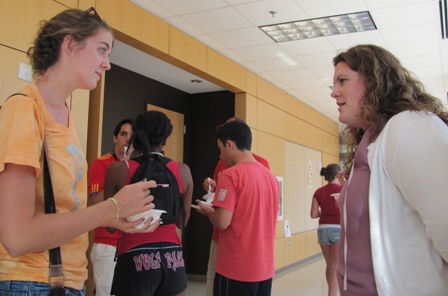
New students in the NC State College of Natural Resources gather to discuss their summer reading assignmentOn Tuesday, incoming students gathered to share thoughts and reflections from their summer reading, Half the Sky  by Sheryl Wudunn and Nicholas Kristof.   The students discussed ways they can connect to make a difference (on campus, in the community, in our country, and even our world).  
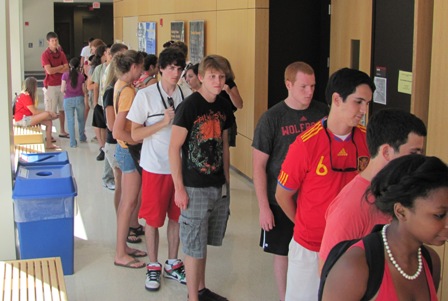
Team building activities helped them forge new relationships and best of all they enjoyed eating Howling Cow ice cream – an important NC State tradition, and delicious! 

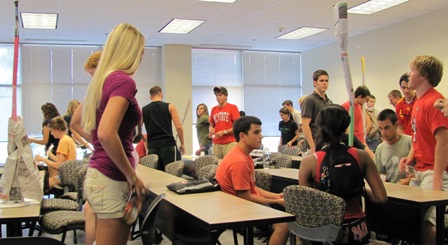
By working in small groups to build the tallest, freestanding tower they could, using only a few office supplies – the students got to know one another. 

New students in the NC State College of Natural Resources engage in a team building exercise during Wolfpack Welcome Week

 To make it even more challenging, the rules changed while the students were building their towers — no talking, build using only one hand, etc.  The Result – reflection, fun, new friends and a growing sense of belonging to the college.   And best of all – the winning group was first in line for ice cream!

Students get help during College Connections Activity“College Connections was a great way for me to meet others in CNR and get to know some of the faculty.”  Summer Higdon tells us.  “My first couple days of classes have been great because I am beginning to see that every teacher and professor really just wants each of us to succeed, not only in the class, but also in future endeavors.” 

The whole campus gets in on the act of welcoming students, both old and new,  back to campus during Wolfpack Welcome Week.  Every year students can get re-engaged and re-energized.  Higdon had clearly been checking out her options,  “All of the extra-curricular clubs and organizations around campus seem like a great way to get involved and I can’t wait to get started!”

The excitement and energy that these students have already shown has all signs pointing to a FABULOUS year ahead!

NC State Researchers Receive Grant to Convert Lignin into Chemical Feedstocks

NC STATE UNIVERSITY NEWS RELEASE – Aug. 19, 2010

Media Contact: 
Tracey Peake, News Services, 919/515-6142 or tracey_peake@ncsu.edu

FOR IMMEDIATE RELEASE

Researchers at North Carolina State University have received a grant aimed at finding an energy efficient and environmentally friendly method for breaking down lignin-a renewable, energy-rich raw material found in plants-into feedstock for  the petrochemical industry, which produces everything from fuel to pharmaceuticals.

NC State scientists Dr. Dimitris Argyropoulos, Finland Distinguished Professor of Chemistry, and Dr. Elon Ison, assistant professor of chemistry and a green chemistry specialist, have received a $500,000 National Science Foundation (NSF) grant via the Industrial Research Institute (IRI) for their research “Catalytic Oxidation Chemistry Aimed at Upgrading Lignin.” 

Lignin is found in woody biomass and the by-products of the pulp and paper and bioethanol industries. Approximately 1.3 billion tons of biomass are available annually in the United States, which could produce up to 130 billion gallons of biofuels, as well as other petrochemical products. However, the fundamental science necessary to convert lignin into chemical feedstocks  has not been adequately addressed.

Argyropoulos and Ison aim to develop the science for catalytically transforming lignin by using liquid carbon dioxide, an environmentally-friendly process, thereby creating an economically viable resource for the petrochemical industry.

“It will be a win-win-win situation if we are successful,” Argyropoulos says. “We will be making use of a renewable material, eliminating industrial waste, the end product will be immediately usable to supply our existing industrial infrastructure, and our conversion method is environmentally friendly.”

This grant is part of IRI’s Industry-Defined Fundamental Research program, designed to bring together leaders in industrial science to identify research that will directly affect the success of the American chemical industry, and to partner with universities and companies to explore this research.
 
The Department of Forest Biomaterials is part of NC State’s College of Natural Resources. The Department of Chemistry is part of NC State’s College of Physical and Mathematical Sciences.

NC Energy Office Stimulus Grants Support CNR’s Student Internship Program

Triangle Business Journal Logo


Excerpted from Triangle Business Journal  –
July 20, 2010
by Amanda Jones Hoyle


NC Energy Office grants $5.6M in stimulus funds

The North Carolina Energy Office is doling out $5.6 million in federal American Recovery and Reinvestment Act funds to create an internship program that will employ 400 North Carolina students training in green-energy related fields.

The federal funds are being combined with $3 million allocated from public and private agencies in North Carolina to fund the program, which will create jobs and internships for college students and recent graduates. More than 20 private businesses, public agencies and universities are expected to participate, according to information from the North Carolina Department of Commerce.

The N.C. Energy Office created the program with money from the federal American Recovery and Reinvestment Act to provide green-energy-related internship and fellowship programs for North Carolina undergraduate and graduate students.

N.C. State University’s College of Natural Resources in Raleigh will use its $435,481 grant to hire 45 interns and three fellows with master’s degrees. An internship experience is a course requirement for completion of a degree in several majors within the department.

Read the complete article in the Triangle Business Journal

Study Shows Race, Not Experience, Impacts Hiring In Sports World

Heidi GrappendorfNEWS RELEASE – July 7, 2010
For More Information:
Caroline Barnhill  /  News Services  / 919.515.6251 caroline_barnhill@ncsu.edu
Dr. Heidi Grappendorf  /  919.513.0060  heidi_grappendorf@ncsu.edu

If you want to get your foot in the door of the sports industry, your race may mean more than your experience. That’s the major result of a new study from North Carolina State University that examined hiring decisions for entry-level sports management positions.

“Previous research has shown that management positions in the sports industry continue to be dominated by white males – and that a prejudice against blacks in managerial positions exists because of a perceived ‘lack of fit’ between being black and being a manager or leader,” explains Dr. Heidi Grappendorf, assistant professor of parks, recreation and tourism management at NC State. “We wanted to find out – when all other factors were considered equal – what  impact  race had on hiring for entry-level sports management positions.”

In the study, researchers created one-page resumes for fictitious job applicants. The resumes  all included identical work and education experience, but changed factors such as race, sex and previous participation as an athlete. The results showed resumes with traditional black names rated significantly lower than their white counterparts in terms of overall likeability, competency and likelihood of being hired.

The study showed male athletes benefit most from having an athletic background – as they have been evaluated as more competent for upper-level positions when compared to male non-athletes, female athletes and female non-athletes with identical athletic qualifications. While white male athletes did not receive significantly higher ratings than the other applicants (i.e., both blacks and whites), they did receive the highest ratings of all groups in both hiring and competence ratings.

“Our findings indicated that for black males and females, athletic participation provided no advantage in hiring recommendations,” Grappendorf says. “Clearly, athletic participation is not ‘superseding’ race. This contradicts previous findings indicating that the athletic role could be beneficial in the hiring process.”

Grappendorf and fellow researchers Laura Burton, from the University of Connecticut, and Angela Henderson, from the University of Northern Colorado, recently presented their findings at the 2010 North American Society of Sport Management Conference.

NC State’s Department of Parks, Recreation and Tourism Management is part of the university’s College of Natural Resources.

-barnhill-

Note to editors: The study abstract follows.

“Examining the Influence of Race, Gender, and Athletic Participation on Hiring Preferences in Sport Management”

Authors: Heidi Grappendorf, North Carolina State University; Laura Burton, University of Connecticut; and Angela Henderson, University of Northern Colorado

Presented: June 3, 2010, North American Society of Sport Management Conference in Tampa, Fla.

Abstract: Lapchick (2008), in the Racial and Gender Report Card that reports the hiring practices of women and people of color in leading sports organizations, reported that representation of racial minorities at NCAA institutions declined in comparison to previous report cards. In addition, the majority of general managers, senior administrators, and professional administrators in major league sports continue to be dominated by White males (Lapchick). Overall, there exists significant racial inequality in the general United States labor market (Bertrand & Mullainathan, 2004). Studies have shown that when employers were faced with a White and a Black applicant who share similar educational backgrounds and work experience, the White applicant was more likely to be chosen for employment and that employer prejudice or the perception of race may signal lower productivity of the Black applicants (Bertrand & Mullainathan). Prejudice can arise from the relations that people perceive between the characteristics of members of a social group and the requirements of the social roles that group members occupy (Eagly & Karau, 2002). When perceivers hold a stereotype about a social group that is incongruent with the attributes that are thought to be required for success in certain classes of social roles, a potential for prejudice exists. These stereotypes may potentially affect how males and females perceive Blacks in management and could even impact how they are judged once they enter the workforce.